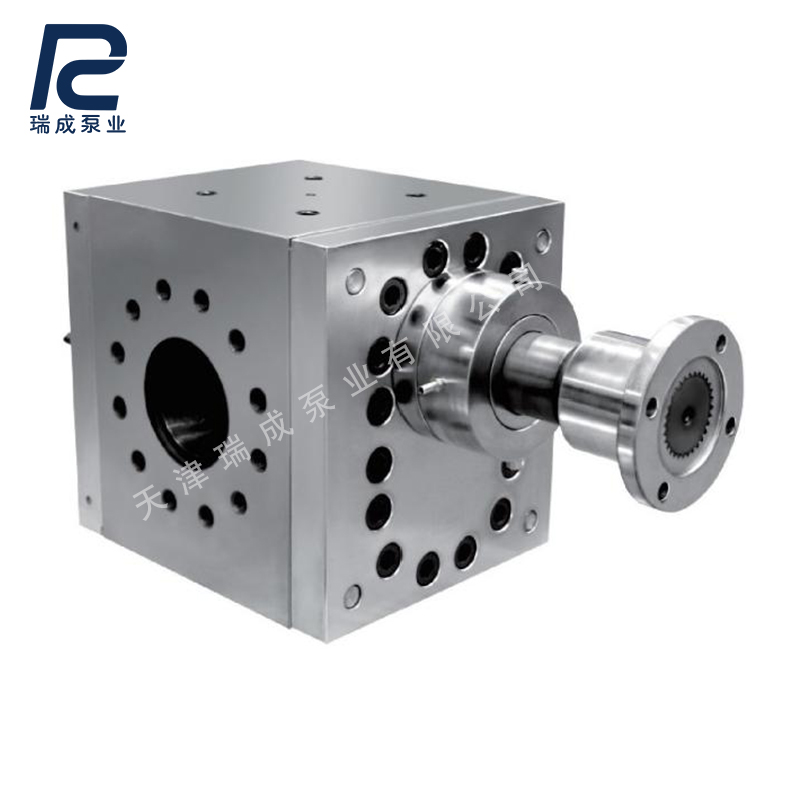
TPU is a thermoplastic polyurethane elastomer that combines elasticity, wear resistance, and processability. It is commonly used in the production of films, sheets, hoses, cable jackets, sealing strips, and pellets. Compared to ordinary plastics, TPU melt is more sensitive to temperature, shear, and residence time. When changes occur in extruder feed rate, screw speed, or filter resistance, die pressure and output volume may fluctuate accordingly, thereby affecting product dimensions, surface finish, and pellet uniformity. A melt gear pump can be installed between the extruder and the die to convey, pressurize, stabilize, and meter the melt.
Positive-Displacement Conveyance Mechanism
Melt gear pumps operate using a pair of meshing gears. Once TPU melt enters the pump chamber, it is continuously conveyed toward the outlet through the spaces between the gear teeth. When the material is fully filled and operating conditions are stable, the pump’s output volume is primarily determined by the unit’s displacement and rotational speed. By adjusting the pump speed via variable-frequency control, the flow rate can be tailored to the production cycle, providing relatively stable feed conditions for the die or pelletizing unit.
Mitigating Pressure and Flow Fluctuations
The extruder screw simultaneously handles plasticization, mixing, and pressure buildup; variations in raw material batches, feeding conditions, and screen resistance can all affect outlet pressure. Installing a melt gear pump effectively isolates upstream fluctuations from downstream molding processes, resulting in a more stable die inlet pressure.
In the production of TPU films, sheets, and hoses, this helps improve the consistency of thickness, outer diameter, and output per unit time; on pelletizing lines, it helps maintain a consistent flow from the die orifices.
Balancing Gentle Conveyance and Temperature Control
Prolonged exposure to heat or excessive shear forces can cause changes in TPU viscosity and color. Therefore, the pump’s flow channels, tooth profile, rotational speed, and clearance must be designed in consideration of material viscosity and output to minimize material retention and localized shear.
The pump’s heating zone should also be coordinated with the temperature zones of the extruder, screen changer, and die head to prevent changes in flow behavior caused by localized temperature differences. It is important to note that gear operation and pressure differentials also generate heat; thus, one cannot rely solely on increasing temperature to reduce the drive load.
Reducing the Extruder’s Pressure-Building Burden
Once the melt pump assumes part of the pressure-building task, the screw can be utilized more for plasticization and mixing, helping to reduce the sustained load on the screw, barrel, and drive system under high backpressure conditions. However, sufficient material supply to the pump inlet must still be maintained. Excessively low inlet pressure, entrapped air in the material, or insufficient temperature can all result in inadequate filling, leading to reduced flow rates or abnormal wear.
Selection and Operating Guidelines
When selecting a melt gear pump for TPU, the choice should not be based solely on port sizes; it is also necessary to comprehensively evaluate the material grade, melt viscosity, operating temperature, output, inlet pressure, outlet pressure, pressure differential, filtration method, and continuous operating time. For TPUs containing fillers or modified components, the wear and corrosion resistance requirements of the pump housing, gears, shaft sleeves, and seal structures should also be assessed.
The equipment should be thoroughly preheated before startup to ensure the material in the pump chamber has softened and to prevent dry running. During operation, record changes in inlet pressure, outlet pressure, motor current, temperature, and rotational speed. When shutting down, develop a material-clearing plan based on the TPU formulation and production cycle to minimize prolonged exposure of residual material to heat inside the pump.
Only through proper pump selection, combined with stable upstream feeding and temperature control, can a melt gear pump fully fulfill its functions of conveying, pressure stabilization, and metering in a TPU extrusion production line.