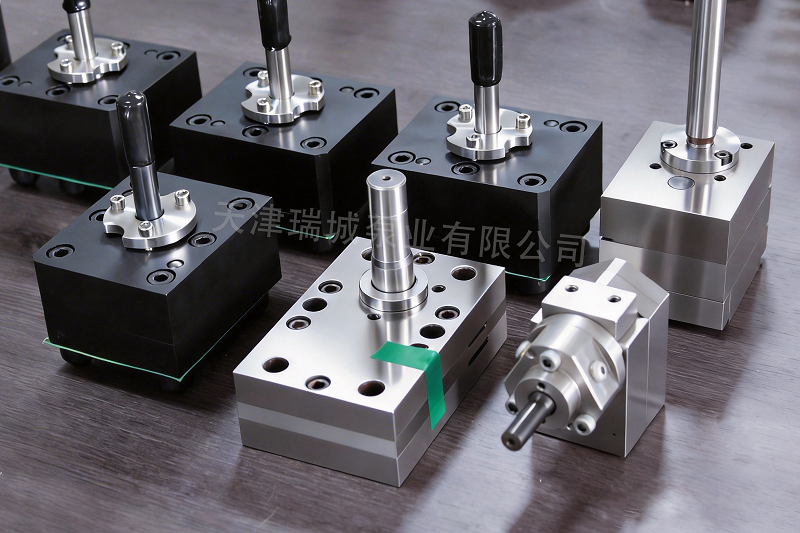
In coating and laminating, hot-melt adhesive processing, and adhesive delivery equipment, the adhesive supply condition affects subsequent coating or dispensing processes. An adhesive gear pump is a positive-displacement metering device primarily used for the continuous delivery of adhesives with a certain viscosity, and it works in conjunction with production lines to provide pressure boosting, pressure stabilization, and flow rate regulation.
Basic Structure of an Adhesive Gear Pump
An adhesive gear pump primarily consists of a pump housing, a drive gear, a driven gear, front and rear end caps, bearings or bushings, and sealing assemblies. The pump housing serves as the mounting structure for all components and contains internal inlet and outlet passages. The drive shaft is connected to the drive unit, which rotates the drive gear; this, in turn, causes the driven gear to rotate synchronously through gear meshing.
Bearings or bushings support the drive and driven shafts, ensuring the gears operate in their set positions. Sealing assemblies are installed on the shaft extension and other locations to prevent adhesive leakage from the mating surfaces. The drive assembly typically consists of a motor, a gearbox, and a coupling, providing continuous rotational power to the pump body.
Operating Principle of Positive Displacement Conveyance
Adhesive gear pumps are positive displacement pumps. As the gears rotate, the adhesive enters the space formed by the gear teeth and the pump casing through the pump inlet and is carried toward the outlet as the gears turn. The drive gear and driven gear re-mesh in the outlet area, expelling the adhesive from the gear teeth, which then enters the downstream piping, coating device, or adhesive supply mechanism.
This process repeats continuously, enabling the adhesive to be delivered backward according to the gear displacement and operating speed. The delivery process relies on the volume changes created by the gears and the pump chamber; therefore, it is suitable for adhesive applications with a certain viscosity.
Delivery, Pressurization, and Pressure Stabilization
Adhesive gear pumps can establish the required outlet pressure in conjunction with the adhesive supply system while delivering the material, thereby ensuring the adhesive can enter subsequent equipment. When fluctuations occur in the upstream supply, the downstream adhesive discharge conditions may also change accordingly. Installed between the feed unit and the coating mechanism, the adhesive gear pump can regulate the pressure and flow rate of the adhesive, thereby reducing the impact of upstream fluctuations on the subsequent dispensing process.
Adjusting Output via Rotational Speed
When upstream supply is sufficient and operating conditions are relatively stable, the pump’s output is primarily determined by the displacement per revolution and the rotational speed. Once the pump specifications are established, the adhesive output per unit time can be adjusted by modifying the operating speed.
During production, the pump speed can be adjusted in conjunction with the coating speed, adhesive consumption, and equipment cycle time to ensure that the adhesive supply is synchronized with subsequent processes.
It is important to note that the adhesive pump alone cannot determine the adhesive discharge status of the entire production line. Upstream feeding, adhesive temperature, operating speed, and the condition of downstream piping must also be maintained within appropriate process parameters.
Performance Characteristics of Adhesive Gear Pumps
Gear-type adhesive pumps integrate the functions of delivery, pressurization, pressure stabilization, and metering into the pump’s operation. With a relatively compact overall structure, they can be combined with a motor, gearbox, and control unit to form an adhesive supply system.
For equipment requiring continuous adhesive supply or adjustments to adhesive consumption based on production cycles, output can be regulated by changing the pump speed. Compared to relying solely on upstream feed pressure to control adhesive output, gear pumps can coordinate with the production line to adjust the adhesive output per unit of time.
When selecting an adhesive pump, it is essential to specify the type of adhesive, operating temperature, viscosity, required flow rate, inlet pressure, and outlet pressure, and to determine the displacement and rotational speed based on continuous operation requirements. Properly matching the pump model, drive unit, and piping conditions helps ensure that the adhesive supply is coordinated with the coating or dispensing process.