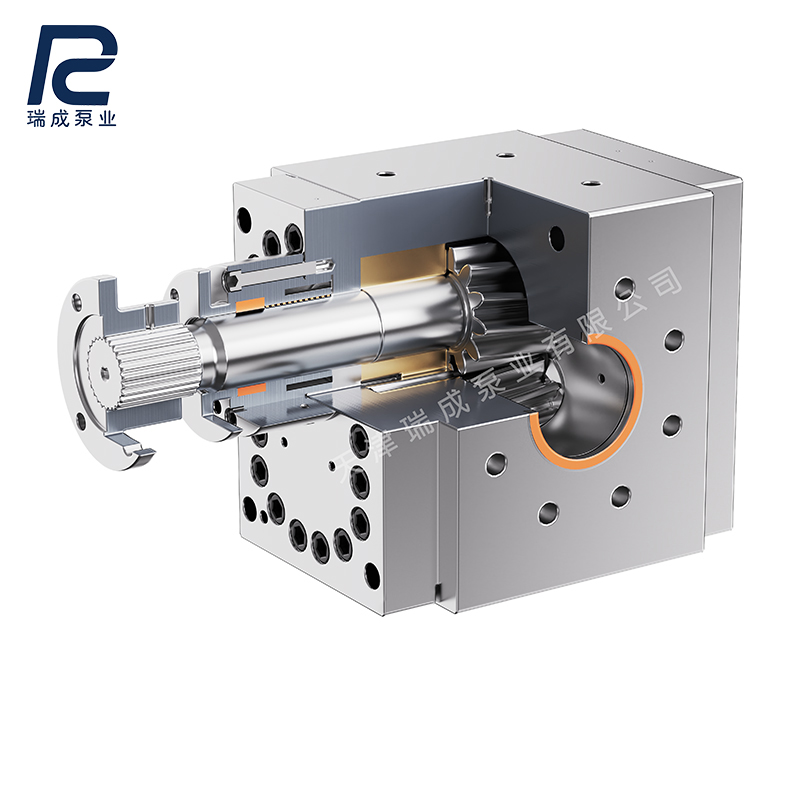
During the production of plastic film, the melt must maintain relatively stable pressure and flow rate before entering the filter, distributor, and die from the extruder. Due to factors such as raw material batches, processing temperature, screw speed, filtration resistance, and equipment wear, fluctuations in material supply may occur at the extruder outlet, which in turn can affect film thickness, transverse uniformity, and production continuity. For production lines that require high feed stability, a melt pump can be installed between the extruder and the die to boost pressure, stabilize pressure, and deliver the molten material in a metered manner.
Melt pumps typically employ a positive-displacement gear design. During operation, the drive gear drives the driven gear to rotate in sync; the melt enters the space formed by the gear teeth and the pump housing and is continuously conveyed to the outlet. Since the pump’s theoretical displacement is directly proportional to the gear speed, adjusting the speed allows for control of melt output within specified operating conditions, thereby minimizing the transmission of upstream feed variations to the die.
In blown film, cast film, BOPP, BOPET, and other film extrusion production lines, fluctuations in die inlet pressure may affect the film forming process. With the addition of a melt pump, the extruder can primarily handle material plasticization and mixing, while the melt pump handles downstream pressurization and stable delivery, resulting in a clearer division of labor between the two pieces of equipment. When the process is properly matched, this helps improve die feed conditions and provides the necessary equipment conditions for film thickness control and continuous production.
Melt pumps can also share some of the pressure-building tasks of the extruder. When filter resistance increases or the pressure required at the die end is high, relying primarily on the screw to build pressure may increase the extruder’s operating load. With a melt pump installed, operating parameters can be adjusted based on inlet pressure, outlet pressure, and motor load; however, the effectiveness of these adjustments is influenced by factors such as raw material viscosity, temperature, equipment specifications, and control methods, and cannot be assessed in isolation from specific operating conditions.
Installing a melt pump on a film production line is not simply a matter of selecting a larger displacement. When selecting a model, comprehensive calculations should be performed based on the extruder’s actual output, material type, melt viscosity, processing temperature, target flow rate, inlet and outlet pressures, filter resistance, and die structure. A displacement that is too small may limit production capacity; conversely, a displacement that is too large combined with insufficient inlet feed may result in excessively low inlet pressure and unstable flow. Therefore, the melt pump’s displacement, speed range, and the extruder’s feeding capacity must be properly matched.
The installation location should also be determined in conjunction with the overall line configuration. A common configuration is to position the melt pump downstream of the extruder and upstream of the die, equipped with pressure sensors, temperature control, a drive system, and interlock protection. The pump must be thoroughly preheated before startup. It should be started at low speed only after the pump body and material temperatures have reached the process requirements to avoid forced operation while cold. During production, attention must be paid to inlet pressure, outlet pressure, drive torque, seal condition, and filter pressure differential to prevent material shortages, overpressure, or abnormal temperatures.
Tianjin Ruicheng Pump Industry can provide melt pump selection and configuration recommendations based on the material characteristics, production capacity range, and installation conditions of the film production line. Specific configurations should be based on on-site process data and equipment conditions. Through proper selection, standardized installation, and parameter tuning, the melt pump can more effectively contribute to pressure stabilization, pressure boosting, and continuous conveyance during the film extrusion process.