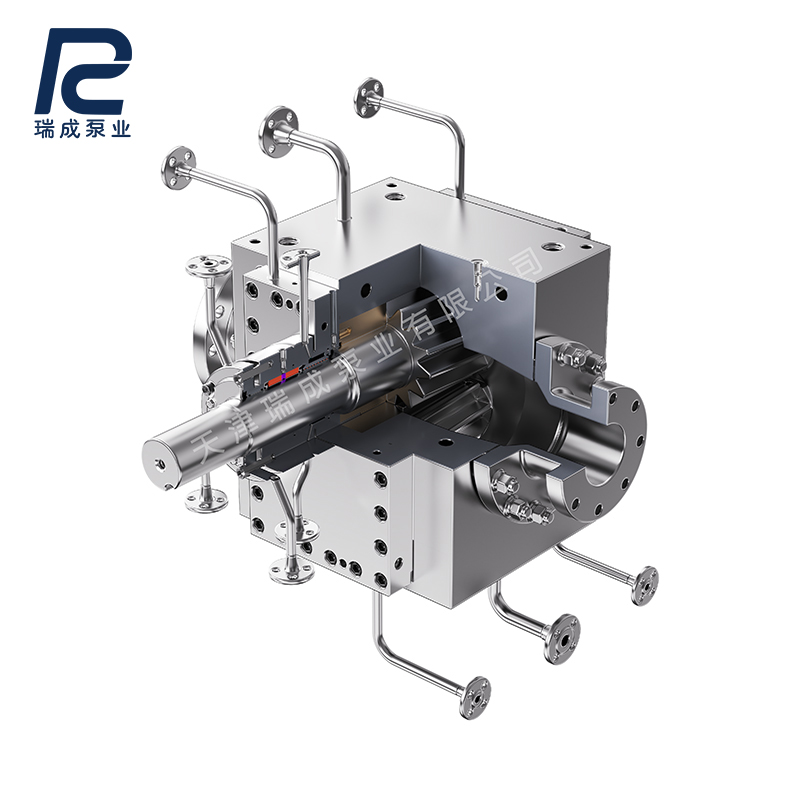
During polymer production and conveyance, the melt often must pass through long pipelines, filtration devices, screen changers, or static mixers before entering the die and subsequent equipment. Factors such as variations in upstream feed, fluctuations in material temperature, increased filtration resistance, and pressure losses in the piping system can cause pressure instability within the pipes, which in turn affects the continuous operation of downstream processes. The function of a melt pipeline booster pump is to boost the pressure of the high-temperature melt, stabilize the pressure, and ensure continuous conveyance through the piping system, thereby minimizing the transmission of upstream fluctuations to downstream sections.
Melt pipeline booster pumps typically employ a positive-displacement gear pump design. During operation, the drive gear rotates the driven gear in sync; the melt enters the enclosed space formed by the gear teeth and the pump housing and is continuously conveyed toward the outlet. Since the pump’s theoretical delivery capacity is primarily related to displacement and rotational speed, a relatively continuous flow output can be achieved when the inlet feed is sufficient and the material state is stable.
Compared to relying solely on upstream equipment to establish pipeline pressure, a booster pump can isolate upstream pressure fluctuations to a certain extent. When there are slight changes in reactor discharge rate, extruder speed, or material viscosity, the control system can adjust the pump’s operating speed based on feedback from pressure sensors, maintaining the outlet pressure within a set range and reducing sudden pressure fluctuations. At the same time, by assuming part of the pressure-building task, the booster pump also helps alleviate the conveying load on upstream equipment.
Whether a booster pump can effectively stabilize pressure also depends on its gear structure, internal clearances, and drive control. Optimal gear parameters and flow path design help minimize flow pulsations generated during gear meshing; appropriate clearance between the gears and bushings reduces backflow of melt from the high-pressure side to the low-pressure side. Variable-frequency motors, gear reducers, and closed-loop pressure control systems can adjust the speed in response to operating conditions, thereby improving system response.
Temperature stability is also a key factor in reducing pressure fluctuations. The viscosity of the polymer melt varies with temperature; when temperature differences exist in the pump body, piping, or filters, localized changes in viscosity may alter the flow resistance. Therefore, pipeline booster pumps typically require electric or thermal oil heating systems configured according to the medium temperature and on-site heat source conditions. The pump must be thoroughly preheated before startup to ensure that the pump body temperature matches the melt process temperature.
In practical operation, it is also essential to ensure an adequate supply of material at the inlet to prevent material starvation, air entrapment, or excessively low pressure at the pump inlet. Filter clogging, excessive pipe bends, improper pump speed settings, misalignment of the coupling, and component wear can also cause abnormal pressure conditions. Operators should periodically check the inlet and outlet pressures, temperatures, motor current, and seal condition, and adjust operating parameters based on material viscosity, flow rate, pipeline resistance, and pressure differential requirements.
The pressure stabilization performance of a melt pipeline booster pump is not determined solely by the pump itself; it also requires coordination with upstream feeding equipment, piping, filtration systems, heating devices, and control programs. When selecting a pump model, parameters such as the name of the medium, viscosity, temperature, throughput, inlet pressure, outlet pressure, and installation method should be provided to determine the pump’s displacement, rotational speed, material, and heating method based on specific operating conditions. Through proper selection and standardized operation, relatively stable process conditions can be provided for continuous melt conveyance and subsequent production.