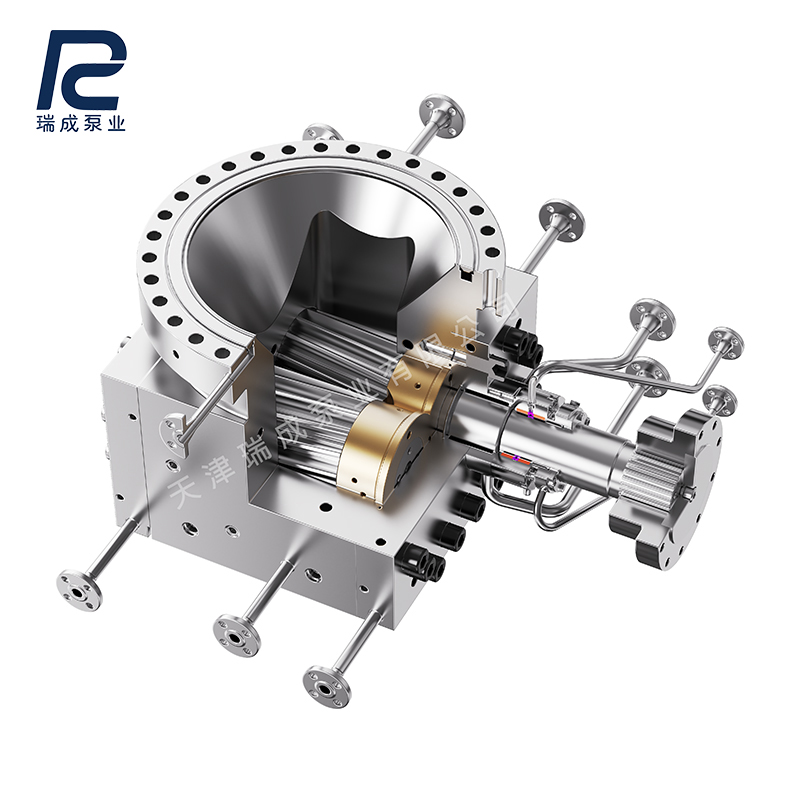
During reactor discharge, polymer transfer, and the handling of high-viscosity media, the inlet pressure condition is one of the key parameters to consider when selecting a bottom-mounted pump. Some production sites involve vacuum or slight negative pressure operating environments. In such cases, the bottom-mounted pump installed at the bottom of the reactor must not only discharge, pressurize, and transfer the material but also be appropriately selected based on the inlet pressure conditions.
From a practical application perspective, some bottom-mounted pumps can adapt to a certain range of inlet vacuum conditions based on operational requirements. According to relevant technical documentation for bottom-mounted pumps, these pumps are typically designed to handle high-viscosity media, low inlet pressures, and bottom-mounted installation configurations, and are used to facilitate the continuous discharge of material from the bottom of the reactor. However, it should be noted that the suitability of a bottom-of-reactor pump for vacuum inlet conditions cannot be determined in isolation; rather, it requires a comprehensive analysis that considers the vacuum level, material viscosity, operating temperature, discharge pressure, pressure differential range, seal type, and on-site piping conditions.
Bottom-of-reactor pumps predominantly employ a positive-displacement gear-type conveying mechanism. During operation, the meshing of gears creates a change in displacement, drawing the material from the inlet into the pump chamber and then conveying it to the outlet. For certain medium- to high-viscosity materials, this design helps improve the continuity of discharge from the bottom of the reactor and, to some extent, reduces the impact of upstream feed fluctuations on subsequent processes.
However, when using a bottom-mounted pump under vacuum or slight negative pressure conditions, special attention must be paid to the inlet feed conditions. If the inlet vacuum is too high, the material has poor flowability, temperature control is unstable, or there are air leaks or excessive resistance in the piping, the pump’s suction performance may be compromised, leading to issues such as insufficient flow, pressure fluctuations, increased noise, or seal malfunctions. Therefore, when selecting a bottom-of-reactor pump for vacuum applications, one must not focus solely on discharge capacity but must also carefully verify the inlet conditions and system compatibility.
For bottom-discharge applications in reactors, it is generally recommended to select a bottom-discharge pump with an appropriate design based on the material’s characteristics. For example, for high-temperature, high-viscosity materials, or those that become more viscous as they cool, heat transfer oil heating or electric heating insulation structures may be considered in conjunction with on-site conditions; for applications with low inlet pressure, attention should be paid to the inlet size, installation method, speed range, and seal configuration.
When selecting a bottom-discharge reactor pump, Tianjin Ruicheng Pump Industry analyzes parameters provided by the customer—such as material name, viscosity range, operating temperature, inlet pressure, outlet pressure, reactor interface dimensions, required flow rate, and installation space—to assist users in choosing the most suitable pump configuration.
In summary, under certain conditions, the inlet of a bottom-discharge pump can accommodate vacuum or slight negative pressure conditions; however, this must be determined based on specific production conditions. A reasonable pump design, sealing method, heating and insulation configuration, and piping layout help improve the continuity and operational stability of the discharge process at the bottom of the reactor.