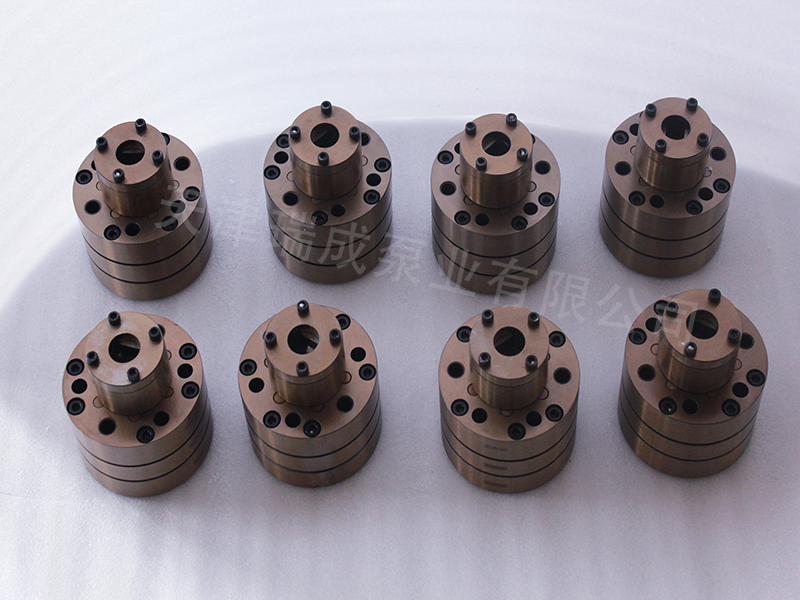
In the chemical fiber spinning process, the melt or spinning solution typically requires stable, continuous, and uniform metering and delivery before entering the spinneret assembly. For the production of filaments such as polyester, nylon, and polypropylene, the feed conditions at the front end affect yarn bundle formation, denier uniformity, and the stable operation of subsequent drawing and winding processes. Therefore, spinning pumps play a critical role in metering and conveying within synthetic fiber spinning systems.
Spinning pumps, often referred to as spinning metering pumps, typically employ a precision gear metering mechanism. Their basic operating principle is as follows: a motor or drive system rotates the drive gear, causing the driven gear to move in synchronous meshing. The melt or spinning solution enters the enclosed gear-and-casing chamber formed between the gears and the pump body through the pump inlet and is continuously conveyed along the pump chamber toward the outlet as the gears rotate. When the gears re-mesh on the outlet side, the gear-cavity volume decreases, and the material is discharged steadily into subsequent stages such as the spinning tank, filter assembly, or spinneret.
Compared to conventional conveying equipment, spinning pumps place greater emphasis on “metered” and “stable” operation. Within a certain speed range, the theoretical volume conveyed per revolution of the gears remains relatively constant; therefore, the output flow rate per unit time can be controlled by adjusting the pump speed. For porous spinnerets or multi-head spinning processes, a stable flow rate helps reduce fluctuations in material supply, ensuring a relatively balanced melt supply to each spinneret orifice and thereby providing more stable process conditions for filament formation.
In actual production, the performance of a spinning pump depends not only on displacement and rotational speed but also on factors such as material viscosity, temperature, inlet pressure, outlet pressure, filtration resistance, and transmission accuracy. If temperature control is unstable, material viscosity may change; if the inlet feed is insufficient, it may result in uneven metering or pressure fluctuations; and if filtration resistance varies significantly, it will also affect the downstream spinning conditions. Therefore, when selecting and using spinning pumps, a comprehensive assessment must be made based on the production line’s output, the type of fiber being spun, the structure of the spinneret assembly, and on-site process parameters.
In the design and application of gear metering pump products, Tianjin Ruicheng Pump Industry Co., Ltd. focuses on the structural precision of the pump body, the stability of gear meshing, material compatibility, and adaptation to on-site operating conditions. For the chemical fiber spinning sector, the company provides appropriate spinning pump products and selection recommendations based on customers’ material characteristics, flow rate requirements, installation methods, and temperature and pressure conditions, helping production lines achieve stable melt metering and delivery.
Overall, the role of a spinning pump is not simply to “deliver the material,” but rather to ensure stable metering, uniform feeding, and seamless process integration during the continuous spinning process. The proper selection and standardized use of spinning pumps help enhance the continuity of the spinning process, providing a more stable foundation for subsequent forming, drawing, and winding stages.