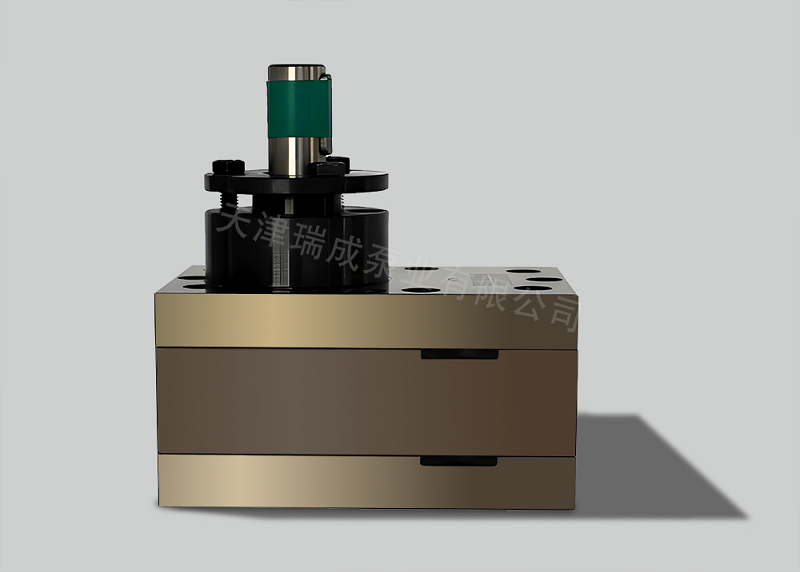
In hot-melt adhesive application, lamination, packaging, sealing, and the production of hygiene products, the stability of the adhesive supply directly affects coating uniformity, bonding performance, and production continuity. Hot-melt adhesives have a certain viscosity and are highly sensitive to changes in temperature and pressure. If adhesive supply relies solely on conventional methods, issues such as fluctuations in adhesive output, unstable adhesive lines, and inconsistent coating thickness are likely to occur. Therefore, many hot melt adhesive production lines utilize hot melt adhesive pumps to achieve continuous, stable, and metered adhesive supply.
Hot melt adhesive pumps typically employ a positive displacement gear pump design. During operation, the motor drives the drive gear to rotate, causing the driven gear to mesh synchronously. The molten hot melt adhesive enters the gear tooth spaces through the inlet and is transported along the inner wall of the pump body to the outlet as the gears rotate. As the gears re-mesh, the adhesive is continuously expelled, creating a stable output flow rate.
The key to achieving precise adhesive dispensing lies in the “fixed displacement” operating characteristic of the gear pump. Within a certain operating range, the amount of adhesive delivered per gear rotation remains essentially constant, resulting in a relatively stable relationship between the pump’s output flow rate and rotational speed. By adjusting the motor speed, the adhesive delivery rate per unit of time can be controlled. When the production line speed increases, the pump speed increases accordingly; when the production line speed decreases, the pump speed decreases in sync, thereby ensuring that the adhesive output remains matched to the production cycle.
The control system adjusts the pump speed based on process settings, production line speed, pressure changes, and other parameters, making the adhesive supply process more stable. For coating, spraying, laminating, and multi-station adhesive supply systems, this control method helps reduce adhesive flow fluctuations, improve coating uniformity, and enhance product consistency.
In addition to metered delivery, hot melt adhesive pumps also provide a degree of pressure stabilization. During hot melt adhesive delivery, changes in filter resistance, increased line length, fluctuations in nozzle pressure, or variations in adhesive viscosity can all affect dispensing stability. By delivering the adhesive continuously and uniformly, gear pumps minimize the impact of pressure fluctuations at the inlet and outlet on the dispensing process, ensuring a smoother coating or spraying process downstream.
Since hot melt adhesives are highly temperature-sensitive, adhesive pumps are typically used in conjunction with heating and insulation systems. This maintains the pump body and flow channels at an appropriate temperature, reducing issues such as increased viscosity and poor flow caused by temperature drops, thereby ensuring the continuity and stability of adhesive delivery.
Overall, hot melt adhesive pumps achieve metered adhesive supply primarily through a positive displacement gear mechanism, fixed displacement output, precise speed control, and stable temperature and pressure management. Through the coordination of these elements, the equipment can continuously and uniformly deliver hot melt adhesive to coating heads, spray heads, or downstream adhesive application equipment, meeting the requirements of hot melt adhesive production lines for stable supply and process continuity.
Tianjin Ruicheng Pump Industry can provide customers with suitable hot melt adhesive pump selection solutions based on adhesive viscosity, temperature, flow rate, pressure, and on-site operating conditions. These solutions are suitable for a wide range of applications, including hot melt adhesive coating, lamination, packaging, sealing, and hygiene materials.