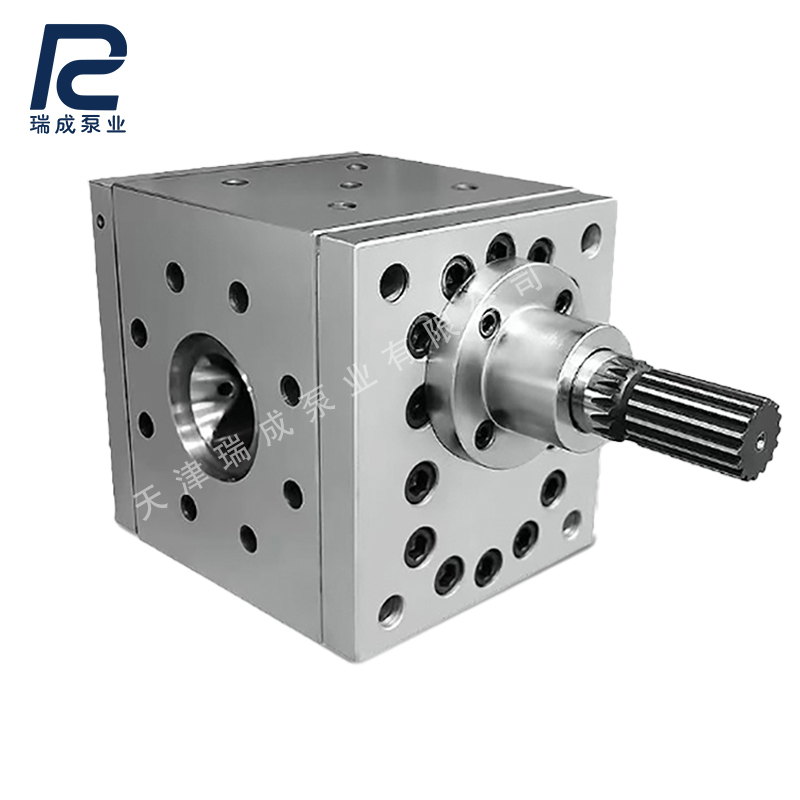
In plastic extrusion, pelletizing, synthetic fiber production, rubber processing, hot melt adhesive applications, and polymer material processing, many customers tend to confuse melt pumps with gear pumps. In fact, melt pumps are a type of gear pump, but they are not conventional low-temperature gear pumps. Instead, they are precision conveying devices specifically designed for high-temperature, high-viscosity, and high-pressure melt applications. Melt pumps are primarily used for pressure stabilization, pressure boosting, and metered delivery of molten materials, whereas standard gear pumps are more commonly used for conveying conventional media such as lubricating oil, hydraulic oil, and low- to medium-viscosity liquids.
In terms of operating principles, both rely on gear meshing to create a change in volume. When the drive gear rotates the driven gear, material enters the space between the gear teeth through the inlet, is carried along the inner wall of the pump body toward the outlet, and is then forced out as the gears re-mesh. In other words, melt pumps and gear pumps share similar fundamental principles and both fall under the category of positive displacement pumps. The key difference lies in the fact that melt pumps handle high-temperature molten materials such as plastics, rubber, resins, and hot melt adhesives, which place higher demands on structural strength, manufacturing precision, wear resistance, sealing performance, and temperature control capabilities.
Conventional gear pumps are generally suitable for liquid media with lower temperatures, lower viscosity, and good flowability, such as oils, lubricants, and hydraulic fluids. Under these operating conditions, the pump’s primary function is to convey the liquid or establish a certain pressure. Melt pumps, on the other hand, are primarily installed between the screw extruder and the die head to ensure the stable conveyance of high-viscosity melts. They not only “convey material” but also serve to stabilize pressure, boost pressure, meter flow, and improve the stability of downstream discharge.
In terms of structural design, melt pumps typically employ higher-precision gears, bushings, pump bodies, and end caps. Due to the high viscosity and significant resistance of the melt, the pump is subjected to higher torque and pressure during operation. Consequently, stricter requirements are imposed on gear strength, bearing load capacity, and internal clearance control. If a standard gear pump is used directly with high-temperature, high-viscosity melt, it is prone to accelerated wear, leakage, pump jamming, unstable output, and even equipment damage.
Temperature control capability is another key distinction between the two. The materials transported by melt pumps are often in a molten state, and temperature fluctuations directly affect viscosity and flowability. Consequently, melt pumps are typically equipped with electric heating, thermal oil heating, or insulation structures to ensure the pump body temperature aligns with the production process. The choice of heating method for melt gear pumps directly impacts the stability of conveying high-temperature, high-viscosity polymer melts. Conventional gear pumps generally lack this heating and insulation design tailored for melt applications.
In terms of performance, melt pumps place greater emphasis on flow and pressure stability. In production lines for sheet, film, pipe, pelletizing, chemical fiber spinning, and hot melt adhesive coating, pressure fluctuations at the inlet directly affect product dimensions, thickness, particle uniformity, or adhesive discharge stability. Through positive displacement delivery and speed control, melt pumps ensure a more continuous and controllable melt output. The flow rate of a melt gear pump is directly proportional to its rotational speed; therefore, the stability of the drive system affects the precision of melt delivery and pressure fluctuations.
From a selection perspective, standard gear pumps primarily focus on flow rate, pressure, medium viscosity, and material compatibility; melt pumps, however, require further consideration of factors such as material type, melt temperature, viscosity range, inlet pressure, outlet pressure, maximum pressure differential, production line output, filtration resistance, die resistance, sealing method, and installation space. Therefore, selecting a melt pump is more about process compatibility than simply purchasing equipment based on flow rate.
Tianjin Ruicheng Pump Industry believes that the core distinction between melt pumps and standard gear pumps lies not in the presence of a gear structure, but in their ability to withstand high temperatures, high viscosity, high pressure, and continuous precision production conditions. For the conveyance of standard low-viscosity liquids, conventional gear pumps can meet basic requirements; however, for media such as plastic melts, rubber, resins, hot melt adhesives, and polymers, it is strongly recommended to select specialized melt gear pumps.
In summary, melt pumps can be understood as specialized, high-precision versions of gear pumps designed for the polymer processing industry. While their operating principles are similar, they differ significantly in application scenarios, structural requirements, temperature control methods, seal design, and control precision. When selecting equipment, companies should choose the appropriate pump model based on actual operating conditions and avoid substituting standard gear pumps for melt pumps, as this may compromise production stability and equipment performance.