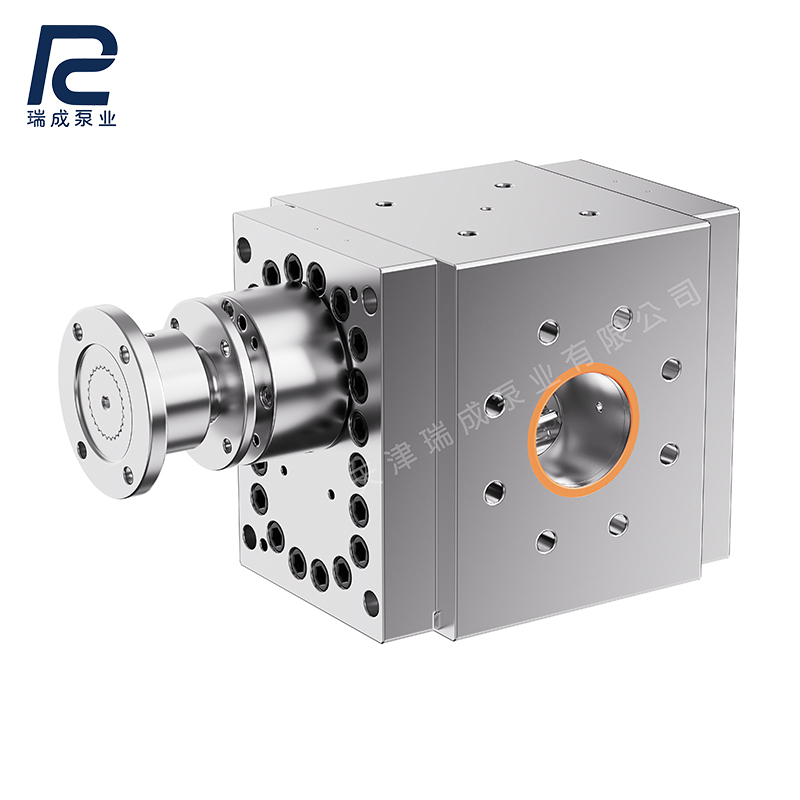
When manufacturing PVC pipes, profiles, or sheets, a common issue arises on the production line: the screw speed remains unchanged, yet the die pressure fluctuates, causing the output to vary erratically. As a result, the cross-sections of pipes and profiles become unstable, and the thickness of sheets requires constant readjustment.
These issues do not necessarily stem from the die. Changes in feed conditions, material plastification, barrel temperature, and screen resistance all affect die pressure. The extruder must both plastify the material and push the melt through the filtration system and die; even a slight change in resistance in the downstream section can affect the output of the entire line.
Pressure Generation by the Melt Pump
Melt gear pumps are typically installed between the extruder and the die. After the material is plastified, it enters the pump chamber and is transported from the inlet side to the outlet side as the gears rotate.
When material supply is adequate, the volume of melt delivered per pump revolution remains relatively constant. As a result, die feed no longer depends solely on changes in screw outlet pressure; operators can also adjust the output volume by controlling the pump speed.
With the addition of a melt pump, the extruder is primarily responsible for plasticization and material supply, while the melt pump generates part of the pressure required by the die head. The screw no longer needs to accelerate frequently to increase die head pressure, making it easier to maintain the original plasticization state.
When feed is insufficient upstream of the pump, the melt pump’s flow rate will also decrease; therefore, inlet pressure and drive current must be monitored during production.
Once output stabilizes, downstream adjustments become easier.
In PVC pipe production, a mismatch between melt flow rate and haul-off speed can easily lead to variations in wall thickness and weight per meter. In profile production, fluctuations in output affect shaping and cross-sectional dimensions. In sheet production, uneven die feed may result in thickness fluctuations.
The melt pump speed can be adjusted independently. Maintaining the extruder’s original plasticization rhythm while making minor adjustments to the output volume via pump speed is more direct than simply changing the screw speed.
This does not mean that all product issues will disappear after installing a melt pump. Die runner design, cooling water temperature, draw speed, and the PVC formulation all affect the final product’s quality. The melt pump addresses pressure and flow issues; it cannot replace adjustments to the die, shaping, or cooling systems.
High Sensitivity of PVC Material
PVC is highly sensitive to temperature and residence time. When the temperature is too low, material viscosity increases, leading to higher pump current and load; when the temperature is too high or the material remains in the pump chamber for too long, discoloration, charring, or gas decomposition may occur.
Therefore, PVC melt pump temperature and speed settings cannot be directly copied from those used for other materials. The runner configuration, gear clearance, pump speed, and heating method must all be determined based on the specific formulation. Soft PVC, rigid PVC, and highly filled PVC have different flow characteristics and thus impose different requirements on the pump.
If, during production, you notice an increase in pump current or a decrease in outlet flow rate, first check the material temperature, inlet feed rate, and filter screen resistance; do not immediately increase the pump speed. Before a prolonged shutdown, be sure to complete material discharge and cleaning in accordance with on-site procedures to prevent residual material from remaining in the pump and being exposed to heat.
Melt Pumps and Screen Changers Must Be Used in Conjunction
PVC formulations often contain fillers, pigments, and various additives; when using recycled material, the level of impurities in the raw material may also increase. After a period of use, the resistance of the filter screen will gradually increase.
If the screen changer is installed upstream of the melt pump, a clogged filter screen will affect the feed to the pump’s inlet; if installed downstream, the resistance of the filter screen will increase the load on the pump’s outlet. The specific configuration should be determined based on the production line structure, filtration requirements, and pressure conditions.
Melt pumps can minimize the impact of normal pressure fluctuations on die output, but they should not be operated under normal conditions when the filter screen is already clogged. If abnormal pressures occur before or after the pump, the filter screen and melt passage must still be inspected.
Larger Is Not Always Better
Melt pump selection should not be based solely on the extruder model or motor power. If the displacement is selected too large, the pump will have to operate at low speeds for extended periods during actual production, increasing the residence time of PVC in the pump chamber; if the displacement is too small, the rotational speed must be increased, which will consequently alter the pump load and material shear.
Before selection, it is essential to understand the actual output, processing temperature, material formulation, pressure before the pump, pressure after the pump, and die resistance. It is also important to specify in advance whether recycled material is used in production, the proportion of fillers, and the location of the screen changer.
When selecting a PVC melt pump, Tianjin Ruicheng Pump Industry calculates the displacement and operating speed based on these process data, and then determines the temperature control, sealing, and drive configurations. Understanding the on-site parameters thoroughly is a more reliable approach than selecting a pump model based solely on output.