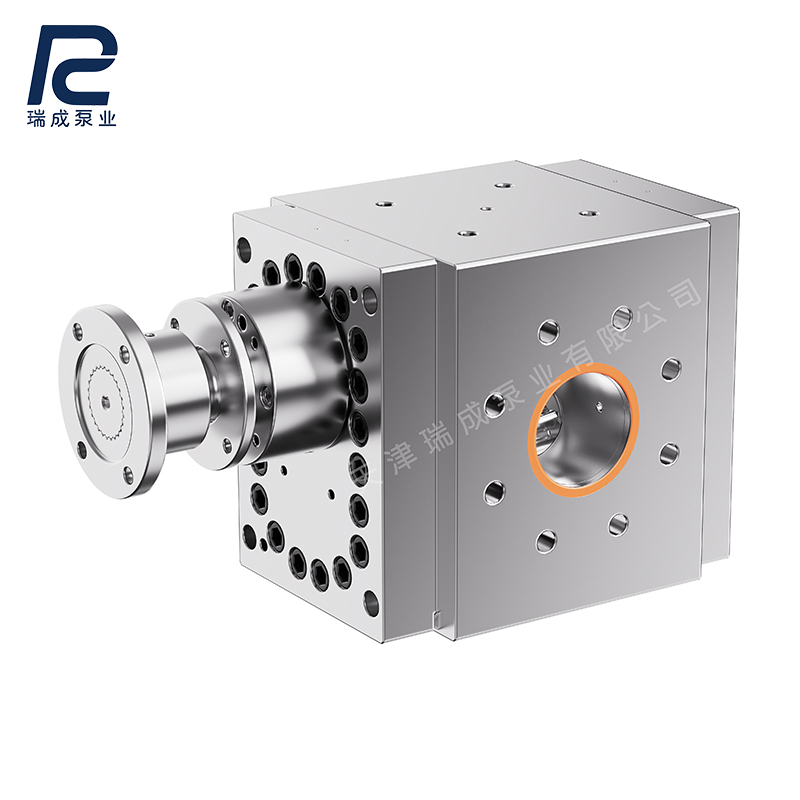
For plastic extrusion production lines that require a high degree of continuity, many customers are concerned about one key question: Can melt pumps operate continuously over the long term, and are they suitable for 24-hour production? From the perspective of equipment principles and practical application, melt pumps are inherently designed for continuous conveying. Provided that the model is appropriately selected, temperatures are stable, pressure is properly matched, and maintenance is thorough, they can meet the operational requirements of continuous production lines.
Melt pumps are typically installed between the extruder and the die, and their primary function is to stabilize pressure, boost pressure, and deliver high-temperature plastic melt in a metered manner. During extruder operation, factors such as variations in raw material batches, screw wear, temperature fluctuations, and changes in filtration resistance can easily cause fluctuations in outlet pressure and flow rate. Through its gear-type positive displacement delivery mechanism, the melt pump conveys the melt to the downstream section at a relatively stable flow rate, thereby minimizing the impact of upstream fluctuations on the die head. This helps address issues such as uneven wall thickness, dimensional variations, and inconsistent particle size in the final products.
However, it is important to note that the long-term stable operation of a melt pump depends not only on the equipment itself but also on the compatibility of the entire production line. First, the displacement should not be selected to be too large or too small. If the displacement is too small, it may limit output; if it is too large, it can result in an excessively narrow low-speed operating range, affecting metering stability. Second, the selection must be based on a comprehensive evaluation of material viscosity, temperature, output, inlet pressure, outlet pressure, pressure differential, heating method, and installation location. For common plastic melts such as PET, PP, PE, PA, ABS, TPU, and EVA, different materials have varying flow characteristics and thermal sensitivity, which in turn impose different requirements on pump body material, gear clearance, sealing methods, and temperature control accuracy.
During continuous 24-hour production, preheating and temperature control are particularly important. Before starting the melt pump, it should be thoroughly heated and maintained at the appropriate temperature to ensure that the pump body, piping, and material reach a state suitable for flow, thereby preventing cold material from entering the pump chamber and causing excessive startup loads, gear wear, or pump jamming. During operation, attention should be paid to whether the inlet pressure is stable, whether the outlet pressure is abnormally high, whether the motor current is fluctuating, and whether there is abnormal noise from the pump body. A clogged filter screen, material degradation, low temperature, or increased pipeline resistance can all lead to elevated pressure and increased equipment load.
For production lines requiring long-term continuous operation, it is recommended to implement interlocked control of pressure, temperature, and rotational speed, and to conduct regular inspections. This includes checking for material leaks at sealing points, verifying the normal operation of couplings, ensuring the stability of the heating system, and listening for abnormal noises from bearings and transmission components. When shutting down, determine whether to clean the equipment based on the material’s characteristics to prevent carbonization, solidification, or other issues that could affect the next startup caused by prolonged material retention.
Therefore, melt pumps are suitable for 24-hour continuous production, provided that the equipment is properly selected to match the operating conditions and that preheating, startup, operation, and maintenance are performed in accordance with specifications. For extrusion production lines operating at high temperatures, with high viscosity, high pressure, or requiring a high degree of continuity, it is recommended to provide the manufacturer with complete operating parameters prior to purchase. Technical personnel should then select the appropriate model based on actual output, material properties, and production line configuration to ensure the melt pump performs more reliably in terms of pressure stabilization, metering, and continuous delivery.