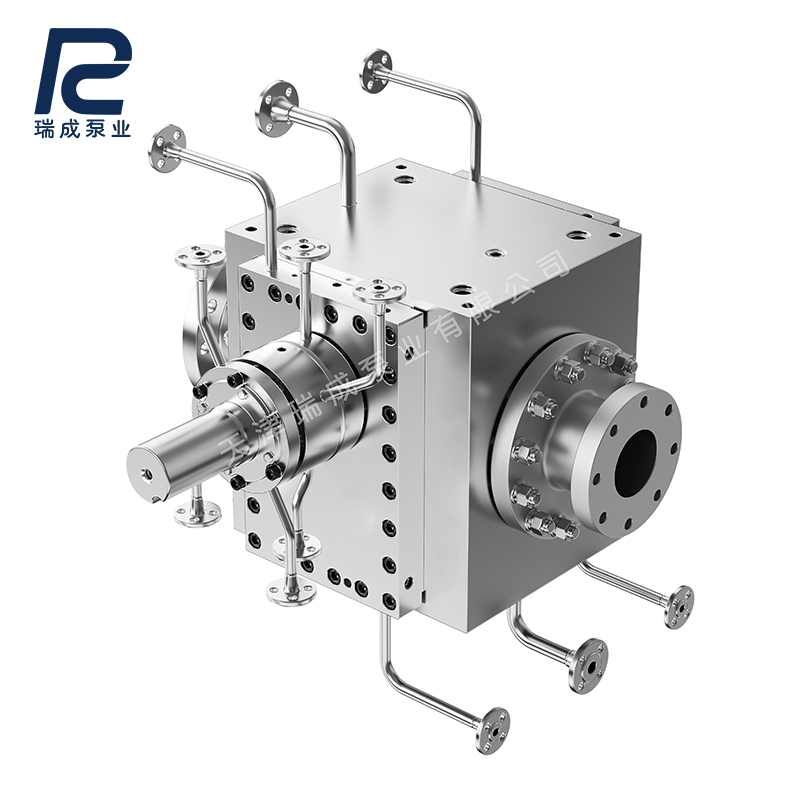
When the outlet pressure of a melt booster pump fails to rise, the first instinct on-site is often to assume that the equipment itself is at fault. However, based on actual operating conditions, abnormal pressure build-up is typically related to a variety of factors, including material supply, temperature, pipeline resistance, the internal condition of the pump, and the control system.
In the continuous processing of polymer materials, melt booster pumps are typically installed between the main machine and downstream equipment such as filters, screen changers, and die heads, where they assist in the continuous conveyance, pressure boosting, and flow control of high-temperature melt. Under normal conditions, the discharge pressure of the melt booster pump varies in response to downstream resistance, pump speed, material viscosity, and changes in process conditions. However, in actual production, some sites encounter situations where “the pump is running, but the discharge pressure does not increase.” In such cases, one should not simply conclude that the equipment is faulty, but rather conduct a step-by-step analysis of the entire production line.
First, check whether the feed from the upstream section is sufficient. Since melt booster pumps are positive-displacement conveying devices, they require a continuous and stable supply of melt at the inlet. Insufficient plasticization in the extruder, fluctuating screw feed, unstable barrel temperature, low inlet pressure, or blockages upstream of the filter or screen changer can all prevent the pump chamber from filling adequately. When feed is insufficient at the inlet, even increasing the pump speed may fail to establish outlet pressure, and may even be accompanied by pressure fluctuations, abnormal noises, or unstable flow.
Second, pay attention to changes in material temperature and viscosity. The flowability of the melt is closely related to temperature; when the temperature is too low, material viscosity increases, raising resistance at the pump inlet and leading to insufficient feed; when the temperature is too high, material viscosity decreases, potentially increasing leakage through clearances within the pump, which similarly affects pressure buildup. Therefore, during troubleshooting, monitor the temperatures of the extruder, pump body, connecting piping, filter, and die simultaneously to verify that the temperature contr
ol in each zone matches the process requirements, avoiding the mistake of focusing solely on a single temperature point while neglecting the overall thermal balance.
Third, check the pump’s rotation direction, speed, and drive condition. The flow direction of a melt booster pump is related to the direction of gear rotation. Issues with motor wiring, inverter parameters, or coupler installation may result in incorrect flow direction or insufficient output. On-site, verify that the motor’s rotation direction matches the direction indicated on the pump housing, and check whether the coupler is slipping, the key connection is loose, or the gearbox is operating normally. Additionally, excessively low pump speed can lead to insufficient flow, making it difficult for the outlet pressure to reach the expected range.
Fourth, investigate whether there are pressure leaks or insufficient resistance in the downstream system. Discharge pressure is not “generated” by the pump alone but is the result of the interaction between the pump’s output flow rate and the resistance of downstream piping, filters, die heads, and other components. If there are leaks in the downstream piping, the bypass valve is not closed, the safety valve opens prematurely, the discharge orifice is too large, or the die head resistance is significantly low, the pressure gauge reading may be lower than expected. For systems equipped with bypass, pressure relief, or recirculation mechanisms, special attention should be paid to valve opening, set pressure, and seal integrity.
Fifth, consider internal wear or changes in clearances within the pump housing. When a melt booster pump continuously conveys materials containing fillers, glass fiber, recycled material, or highly abrasive substances, wear may occur on the gear end faces, tooth tops, shaft sleeves, and inner walls of the pump chamber. Wear increases internal recirculation, causing a portion of the material to flow back from the high-pressure side to the low-pressure side. This manifests as an insignificant increase in pressure despite higher rotational speed, decreased output, or abnormal temperature rise. Such issues require a comprehensive assessment that takes into account operating time, material characteristics, pressure records, and disassembly inspection results.
Furthermore, the pressure gauges, sensors, and control systems themselves must not be overlooked. Sometimes, the apparent pressure deficiency on-site is not due to actual insufficient pressure, but rather to a clogged pressure gauge, sensor drift, signal line abnormalities, or incorrect display parameter settings. It is recommended to use reliable instruments for comparative testing during troubleshooting and to monitor changes in motor current, pre- and post-pump pressures, melt temperature, and output to avoid attributing the problem solely to a single pressure reading.
Overall, failure of a melt booster pump to achieve the desired discharge pressure may be related to multiple factors, including upstream feeding, material temperature, pump speed and rotation direction, downstream resistance, pressure relief mechanisms, internal wear, and monitoring instruments. Tianjin Ruicheng Pump Industry recommends following the troubleshooting approach of “process first, then piping; external factors first, then the pump body; data first, then disassembly and inspection” when addressing issues on-site. Only through a comprehensive analysis that combines material properties, production temperature, inlet pressure, outlet pressure, and equipment operating status can the cause be more accurately determined, providing a basis for subsequent maintenance, equipment selection, or process adjustments.