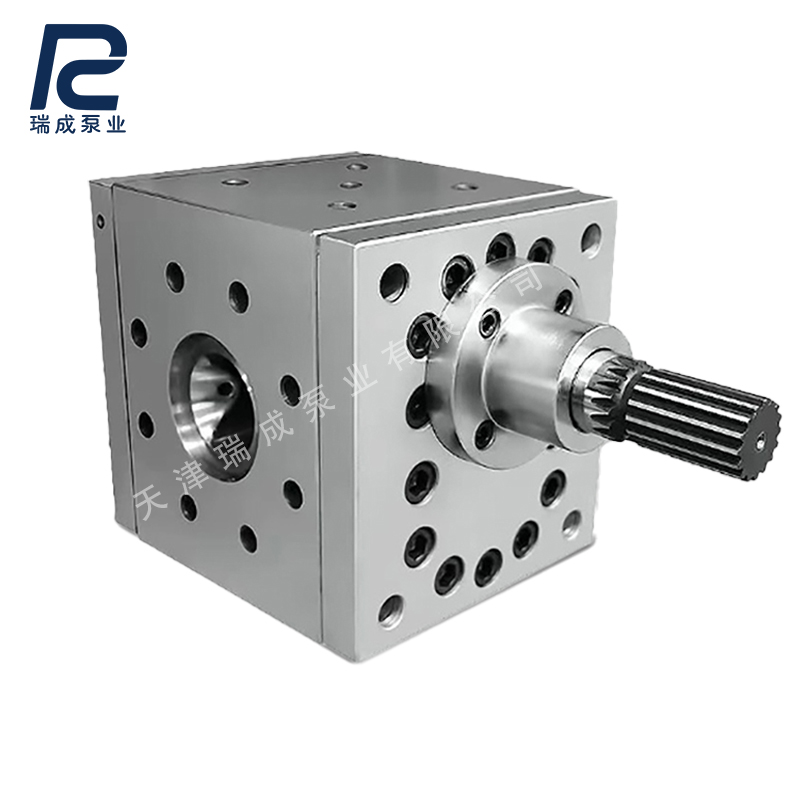
In plastic extrusion, rubber processing, synthetic fiber spinning, hot melt adhesive delivery, and polymer production, many customers often ask the same question when selecting equipment: What exactly is the difference between a melt pump and a gear pump? From a basic structural perspective, a melt pump is a type of gear pump that typically conveys material through a pair of intermeshing precision gears. However, in terms of operating conditions, design requirements, and intended use, melt pumps are not simply substitutes for ordinary gear pumps; rather, they are precision devices specifically designed for the conveyance of high-temperature, high-viscosity, and high-pressure polymer melts.
Ordinary gear pumps are primarily used for conveying lubricating oil, hydraulic oil, low- to medium-viscosity liquids, or general fluids, serving mainly to perform basic conveyance tasks. In contrast, melt pumps handle polymer materials that are already in a plasticized or molten state, such as PP, PE, PET, PVC, PA, TPU, rubber, resins, and hot-melt adhesives. These materials are characterized by high temperatures, high viscosity, and significant flow resistance, placing higher demands on the pump’s structural strength, gear precision, wear resistance, sealing design, and heating/insulation capabilities.
The primary distinction between the two lies first in operating temperature. Standard gear pumps are mostly used for ambient-temperature or low-to-medium-temperature media, whereas melt pumps typically require continuous operation in high-temperature environments. To prevent the material from cooling, solidifying, or losing flowability during conveyance, melt pumps are usually equipped with electric heating, thermal oil heating, or insulation structures based on operating conditions, ensuring the interior of the pump body remains within a temperature range suitable for material flow.
Second, melt pumps demand higher precision in machining and tighter control of internal clearances. As melt pumps operate at high temperatures, components are subject to thermal expansion. If the clearance between gears, bushings, side plates, and the pump chamber is improperly designed, it can lead to increased internal leakage, unstable pressure, reduced flow rate, and even issues such as friction or jamming. Therefore, the manufacturing of melt pumps must not only consider conveying capacity but also comprehensively evaluate factors such as material viscosity, operating temperature, discharge pressure, pressure differential, rotational speed, and continuous operating time.
Furthermore, melt pumps place greater emphasis on pressure stabilization, pressure boosting, and metering functions. In extrusion production, the discharge pressure of the extruder is easily affected by factors such as screw speed, plasticization status, filtration resistance, and temperature fluctuations. If the melt enters the die directly, it can easily lead to issues such as uneven sheet thickness, surface ripples in films, wall thickness deviations in pipes, and inconsistent pellet sizes. By installing a melt pump between the extruder and the die, screen changer, or downstream equipment, the melt can be delivered to the subsequent process at a more stable pressure and flow rate, thereby enhancing production line stability and product consistency.
In terms of application scope, standard gear pumps are more suitable for general liquid transfer, while melt pumps are primarily used in continuous production scenarios such as plastic and rubber extrusion, chemical fiber spinning, hot melt adhesive coating, polymerization reactor discharge, pelletizing, sheet forming, film production, pipe manufacturing, and sheet production. For high-temperature, high-viscosity, and high-pressure operating conditions, selecting a specialized melt pump is often more effective than using a standard gear pump in ensuring stable equipment operation and product quality.
Therefore, the relationship between melt pumps and gear pumps can be understood as follows: melt pumps belong to the gear pump structural system, but they are specialized equipment designed specifically for the demanding conditions of polymer melt conveyance. When selecting a pump, one should not merely consider whether it is a “gear pump”; instead, key attention must be paid to material properties, production temperature, inlet pressure, outlet pressure, displacement, rotational speed, seal type, heating method, and downstream process requirements.
Tianjin Ruicheng Pump Industry Co., Ltd. has long specialized in the R&D and manufacturing of melt gear pumps, rubber pumps, bottom-of-vessel pumps, and pipeline booster pumps, and can provide customized selection solutions based on the specific operating conditions of customers’ production lines. For applications involving the conveyance of plastics, rubber, chemical fibers, hot melt adhesives, and polymer materials, Ruicheng Pump Industry employs rational structural design, precision machining, and rigorous assembly and testing to help customers achieve stable pressurization, continuous conveyance, and precise metering, thereby providing reliable equipment support for the stable operation of production lines.