Tianjin Ruicheng Pump Industry Co., Ltd.'s melt booster pump is a positive-displacement pump whose core working components consist of a pair of precision-meshed gears. As the gears rotate within the pump chamber, the periodic changes in the volume between the teeth enable the suction, pressurization, and steady-pressure delivery of high-temperature, high-viscosity polymer melts. This equipment is widely used in the extrusion molding processes of polymer materials such as plastics and synthetic fibers.
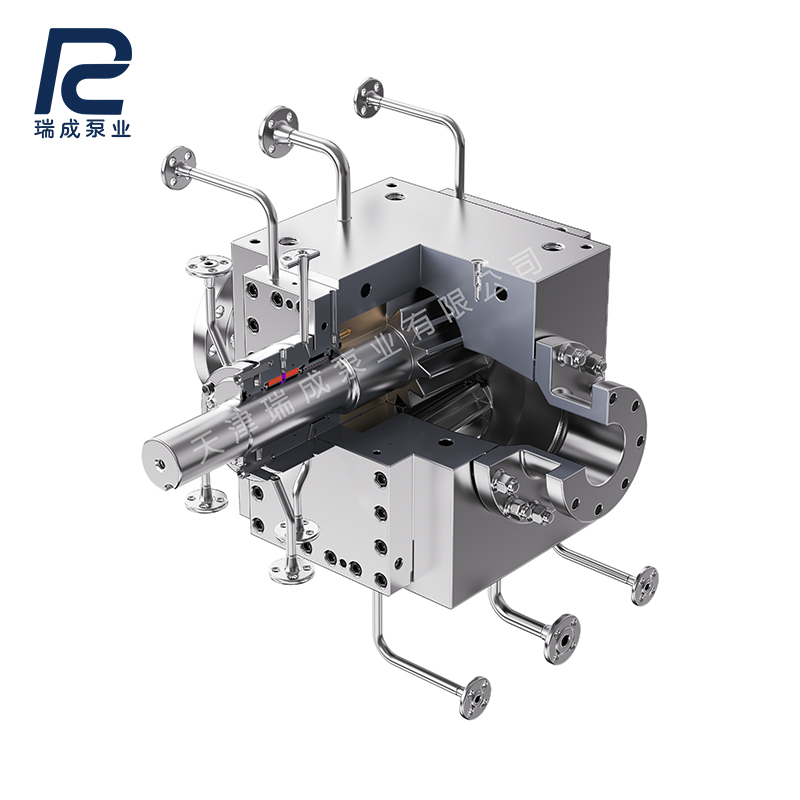
Melt Suction Stage
The motor drives the drive gear to rotate, and the driven gear rotates in the opposite direction in synchronous meshing. On the inlet side of the pump housing, the gear teeth gradually disengage from one another, causing the sealed volume formed between the teeth and the inner wall of the pump chamber to expand continuously, creating a local negative pressure. Driven by the pressure differential between the upstream and downstream sides, high-temperature melt (such as plastic or polyester melt) from the extruder is rapidly drawn in and fills the tooth slots, completing the feeding process.
Sealed Conveyance and Pressurization Stage
The tooth slots filled with melt rotate with the gears into the sealed conveyance zone in the middle of the pump chamber. In this zone, the gears, pump housing, and side plates together form a sealed space. The melt is “enclosed” within this space and moves smoothly with the gears toward the outlet side, with no leakage or pulsation during the process. Upon reaching the outlet side, the two gears mesh again, causing the tooth pocket volume to rapidly decrease. The melt is forcibly compressed, resulting in a significant increase in pressure. Typically, this pump can boost low-pressure melt (with an inlet pressure of 1–5 MPa) to a high-pressure state (with an outlet pressure of 0–15 MPa), meeting the demand for high-pressure melt from downstream molds or spinning assemblies. An extremely thin melt film forms between the precision-meshed gear surfaces, which prevents backflow while also reducing wear and enhancing sealing performance.
Pressure-Stabilized Discharge Stage
The gears continue to rotate at a constant speed, and the melt on the outlet side is discharged at high pressure in a continuous, metered manner. Since the output flow rate of the melt pump is strictly linearly related to the gear speed, the outlet pressure and flow rate exhibit high stability. This pump is capable of suppressing pressure fluctuations generated by the upstream extruder to within ±0.5%, enabling precise metering and stable pressure delivery. The pump housing is equipped with a heating and insulation system to maintain the melt at a constant temperature, preventing solidification or degradation caused by temperature drops, thereby ensuring stable operation under high-viscosity conditions.
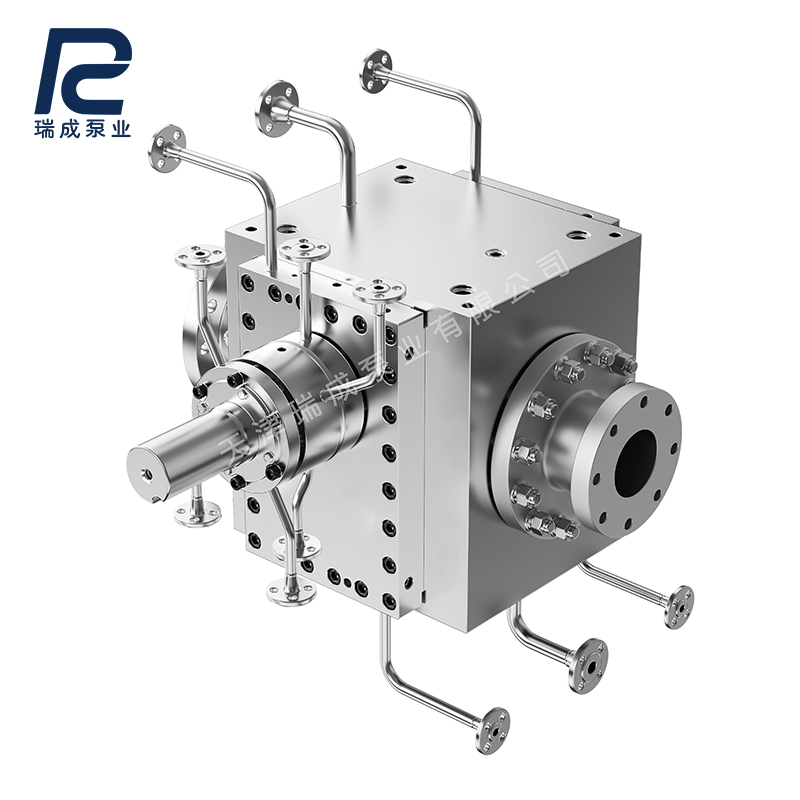
Ruicheng Pump Industry’s melt booster pumps utilize the volumetric displacement caused by gear meshing as their core mechanism. Through a cyclic process of “suction—conveyance—pressurization—stable discharge,” they provide a stable, high-pressure melt flow for polymer material molding processes, making them a key piece of equipment for enhancing product precision and production stability.