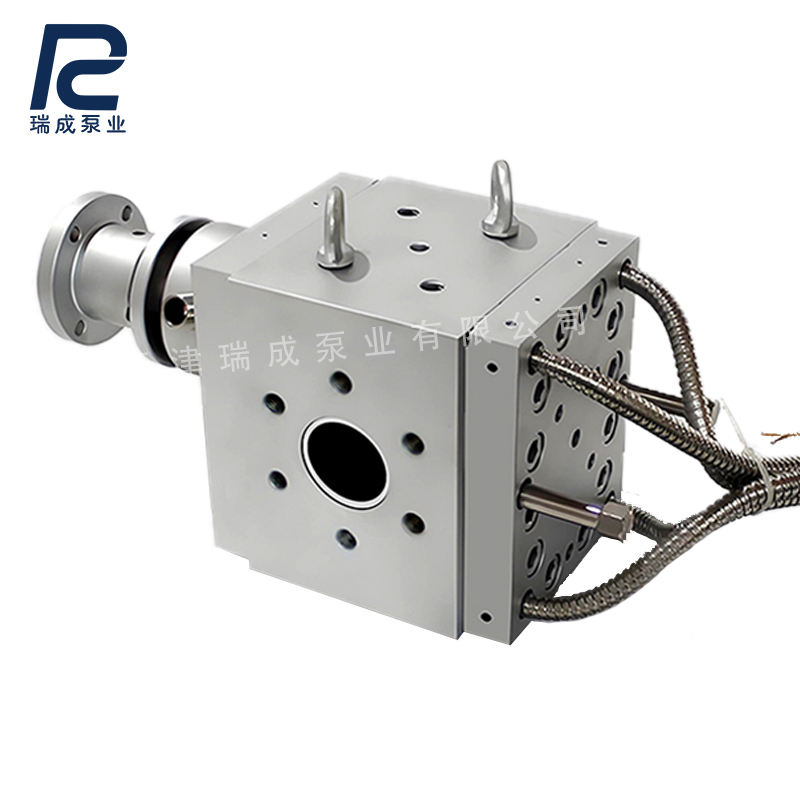
What does a melt pump do in PP sheet production? When extruded sheet shows uneven thickness or locally thin areas after thermoforming, the upstream material supply needs to be checked. Tianjin Ruicheng Pump Industry supplies melt pumps for PP sheet production lines to help improve melt delivery to the die.
During continuous extrusion, changes in screw feeding, material formulation and increasing filter resistance can cause fluctuations in melt pressure and output. If the flow entering the die is unstable, adjusting the die gap or roll speed alone may not provide consistent sheet thickness control.
A melt pump uses rotating gears to continuously convey melt along the pump chamber to the outlet, providing pressure boosting and metering. With sufficient inlet feed, suitable temperature and stable pump speed, it can reduce the effect of upstream fluctuations on die output, supporting sheet thickness control and subsequent thermoforming. The melt pump can also take over part of the pressure-building load, allowing the extruder to focus more on plasticizing and mixing.
Filtration and operating control also require attention. The screen changer captures impurities in the melt, while the melt pump provides pressure boosting and metering. During operation, pump inlet pressure should be monitored and the extruder speed adjusted accordingly. Increasing pump speed alone cannot compensate for insufficient feed.
Tianjin Ruicheng Pump Industry can select pump displacement, drive systems and connection configurations based on the PP material, regrind ratio, hourly throughput, processing temperature and die pressure, providing selection support for new PP sheet lines and equipment upgrades.