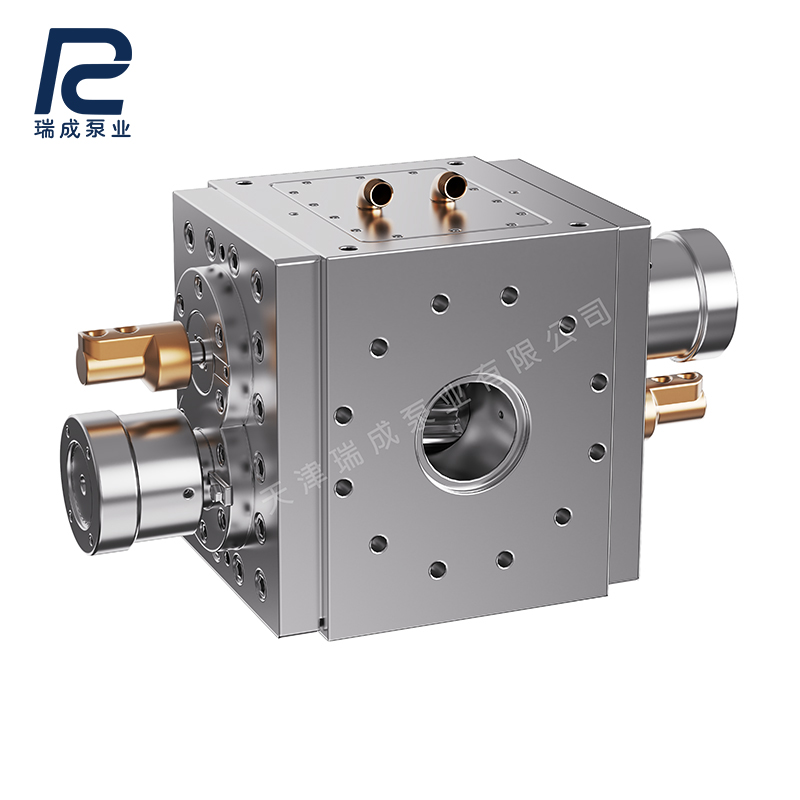
Rubber and elastomer materials have high viscosity, and their flow behaviour is easily affected by temperature, formulation and processing conditions. In extrusion production, relying solely on screw conveyance may result in pressure fluctuations, uneven feeding or variations in output. Rubber melt gear pumps are typically installed between the extruder and downstream equipment, primarily serving to ensure continuous conveyance, pressurisation and a stable flow rate.
Rubber melt gear pumps utilise a pair of meshing gears. During operation, the rubber compound enters the gear pockets and is continuously conveyed by the gears along both sides of the pump chamber towards the outlet. The material is conveyed primarily through the relatively enclosed volumes formed between the gears and the pump housing, rather than passing directly through the meshing area of the two gears. By adjusting the pump speed according to production requirements, the output volume per unit time can be varied.
Controlling Pump Housing Temperature
Certain rubber and elastomer materials are relatively sensitive to temperature. After the material is subjected to compression and shearing within the pump chamber, localised temperatures may rise. If heat cannot be dissipated promptly, scorching, adhesion or changes in material properties may occur.
For such operating conditions, rubber pumps can be fitted with cooling water channels. During operation, cooling water circulates inside the pump housing and carries away localised heat, maintaining the pump temperature within a range suitable for rubber compound delivery. This helps to reduce scorching caused by excessive temperatures, improves the appearance and processability of subsequent products, and minimises the number of defective items resulting from scorching.
However, a lower cooling water temperature is not necessarily better. Water temperature and flow rate must be adjusted in accordance with the rubber compound formulation, feed temperature, viscosity and pump speed to avoid an excessively low pump body temperature, which would cause the material’s viscosity to increase and result in greater pumping resistance.
Suitable for conveying high-viscosity materials
Rubber melt gear pumps can be used to convey rubber and a variety of elastomeric materials. The continuous gear discharge mechanism helps to minimise fluctuations in outlet pressure and flow rate, ensuring a steady supply of material to downstream extrusion, calendering and moulding equipment.
Tianjin Ruicheng Pump Industry can select the appropriate rubber pump specifications—including displacement, rotational speed, sealing configuration and drive type—based on material viscosity, operating temperature, flow rate, inlet and outlet pressures, and cooling requirements.