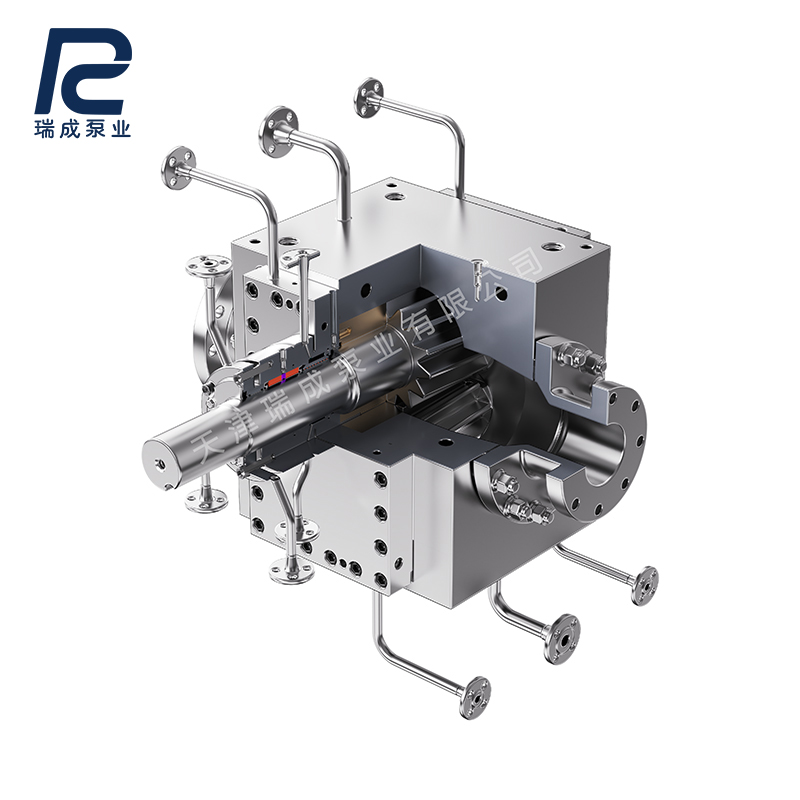
In the production processes of resins, polymers, adhesives and similar materials, once the material has been discharged from reactors, mixing equipment or storage tanks, it often needs to travel through lengthy connecting pipelines before being fed into filtration, degassing, coating, filling or downstream processing equipment.
When the material has a high viscosity, the conveyance distance is long, or the pipework contains a large number of bends, valves and filtration devices, relying solely on the material’s own flow or the pressure from upstream equipment may result in slow conveyance speeds, insufficient outlet pressure and unstable flow rates. A melt pipeline booster pump is installed within the material conveyance pipework, primarily serving to boost pressure, convey the material and stabilise the flow.
I. Pipeline Pressurisation Following Discharge from the Reactor
Certain polymers, resins and adhesive materials, after being discharged from the reactor, need to be conveyed via connecting pipelines to filters, storage tanks or downstream processing equipment. As the pipeline length increases, a certain degree of pressure loss occurs during material conveyance.
Where the discharge pressure from the reactor itself is sufficient to ensure the material enters the pump chamber but is unable to overcome the resistance in the subsequent pipework, a booster pump may be installed in the pipeline to supplement the conveying pressure.
If the pump inlet is under vacuum, at a low liquid level or experiencing insufficient feed, the pump cannot be selected directly based on standard pipeline pressurisation conditions; instead, a reactor discharge pump with good inlet adaptability must be considered.
II. Pipeline Conveyance of High-Viscosity Materials
Hot-melt adhesives, EVA compounds, resins, rubber materials and certain polymer melts are characterised by high viscosity and significant flow resistance. As the material temperature decreases, viscosity may rise further, thereby increasing the difficulty of pipeline conveyance. Pipeline booster pumps can be fitted with heating elements tailored to the material temperature, ensuring the pump body temperature remains appropriately aligned with the process temperature and reducing the issue of reduced flowability within the pump chamber caused by temperature drops.
III. Long-Distance and Multi-Bend Piping
There is a certain distance between production equipment; the longer the pipework, the more pronounced the local resistance and frictional pressure loss tend to be.
Provided the inlet feed is stable, installing a pipeline booster pump at a suitable location can supplement the conveying power and assist the material in travelling through long-distance pipework. The pump’s installation position must be analysed in conjunction with the pipeline layout, inlet pressure and outlet back pressure to avoid excessively low inlet pressure.
IV. High Resistance from Downstream Filtration Equipment
When the melt enters fine filters, screen changers or other equipment with narrow flow channels, a certain degree of flow resistance is created. As impurities gradually accumulate on the filter screens, the pressure differential across the equipment may also change.
A pipeline booster pump can provide the required outlet pressure for the material within a specified pressure differential range, helping the melt to pass through the downstream filtration stages. When configuring the system, the initial pressure differential of the filter, the operating pressure differential, pipeline losses and the pressure required by subsequent equipment should all be taken into account.
V. Pump selection must be based on actual conveying conditions
The specifications of a pipeline booster pump must be determined according to actual production conditions. In addition to the type of material and operating temperature, it is necessary to understand the flow state of the material, the hourly conveying rate, and the pressure conditions at the pump inlet and outlet. If the material contains particles, fillers or other impurities, the material of the flow-passing components and their clearance must also be adjusted.
Furthermore, the length of the pipework, the number of bends, the resistance of downstream equipment and the on-site installation location will also affect the pump’s flow rate, drive power and connection design.
Tianjin Ruicheng Pump Industry can conduct a comprehensive analysis of the pump’s flow rate, materials, seals, drive and control methods, taking into account the properties of the material and on-site parameters, to ensure that the equipment configuration is optimally suited to the actual conveying conditions.