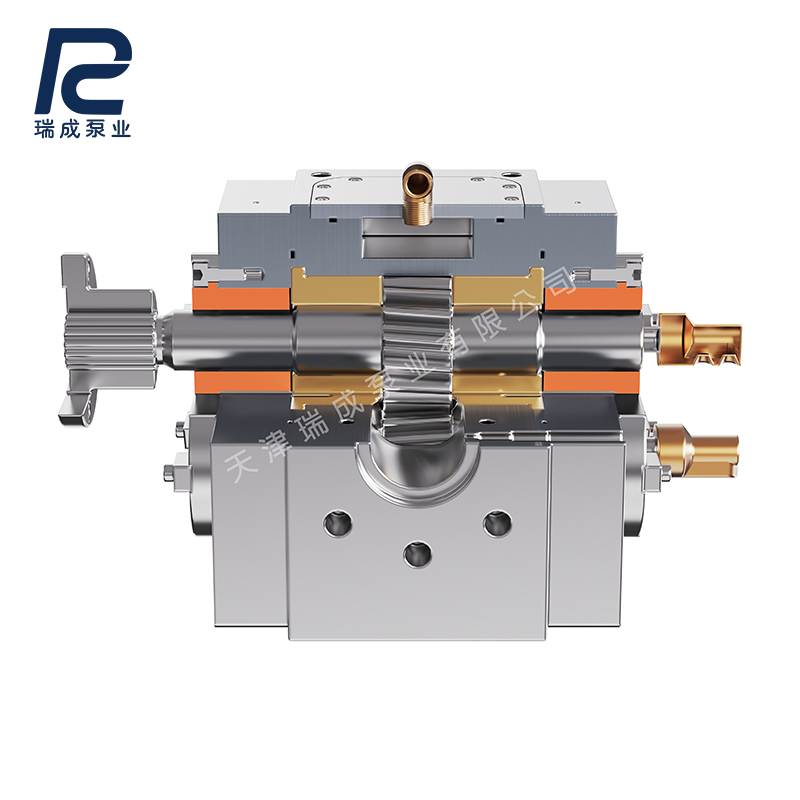
In rubber extrusion processing, the material typically exhibits characteristics such as high viscosity, high elasticity, and significant flow resistance. Changes in feed rate, material temperature, or screw speed can easily cause fluctuations in die pressure and output volume. Rubber gear melt pumps are typically installed between the extruder and the die to convey the rubber compound and assist in pressurization, pressure stabilization, and flow control.
Working Principle of Rubber Gear Melt Pumps
Rubber gear melt pumps are positive-displacement conveying devices. When the material is fully filled and operating parameters are stable, the pump’s output is primarily determined by the pump’s displacement and rotational speed. By adjusting the pump speed, the rubber feed rate can be controlled, thereby reducing the impact of variations in the extruder’s feed rate on the die’s discharge conditions.
Main Functions of Rubber Gear Melt Pumps
First, they provide pressure to the forming die. Pressure loss occurs as the rubber material passes through the filter screen, flow channels, and die. The gear melt pump establishes the required pressure near the die, helping the rubber material pass through subsequent components.
Second, it mitigates pressure fluctuations. Changes in the extruder screw’s feed rate, plasticization state, and rotational speed can all affect outlet pressure. As the conveying link between the extruder and the die, the gear pump acts as a buffer against upstream fluctuations, ensuring a relatively stable supply to the die.
Third, it controls the flow rate of the rubber material. By coordinating the pump’s displacement with its rotational speed, the delivery volume per unit time can be adjusted, providing the process conditions necessary to control the dimensions, wall thickness, and weight per unit length of continuously extruded products.
Fourth, it shares the burden of pressure buildup with the extruder. With a gear melt pump installed, the extruder can focus on mixing and plasticizing the rubber material, while the die pressure is established by the pump, helping to reduce the workload on the front end of the screw.
Applicable Rubber Extrusion Production Lines
Rubber gear melt pumps can be used in automotive seal strip production lines, rubber tube extrusion lines, wire and cable rubber coating lines, tire tread extrusion lines, rubber sheet production lines, rubber strip production lines, and elastomer profile extrusion lines.
In the production of automotive seal strips and profiles, a continuous and stable supply of rubber compound helps minimize variations in cross-sectional dimensions; in rubber tubing and cable coating production, it helps control wall thickness and material consumption per unit length; in tire tread and rubber sheet production, it improves material feeding conditions in the width direction and during continuous production.
The equipment can be configured to meet the processing requirements of natural rubber, styrene-butadiene rubber (SBR), nitrile rubber (NBR), ethylene-propylene-diene monomer (EPDM) rubber, and certain thermoplastic elastomers. Due to differences in the viscosity, operating temperature, and flow characteristics of various rubber compounds, the selection process requires a comprehensive evaluation of material parameters, hourly output, inlet pressure, outlet pressure, pump displacement, drive torque, temperature control methods, and seal configurations.
Tianjin Ruicheng Pump Industry can configure rubber gear melt pumps based on the material characteristics, output requirements, and installation space of rubber extrusion production lines, providing selection guidance for both new production lines and retrofits of existing extrusion equipment.