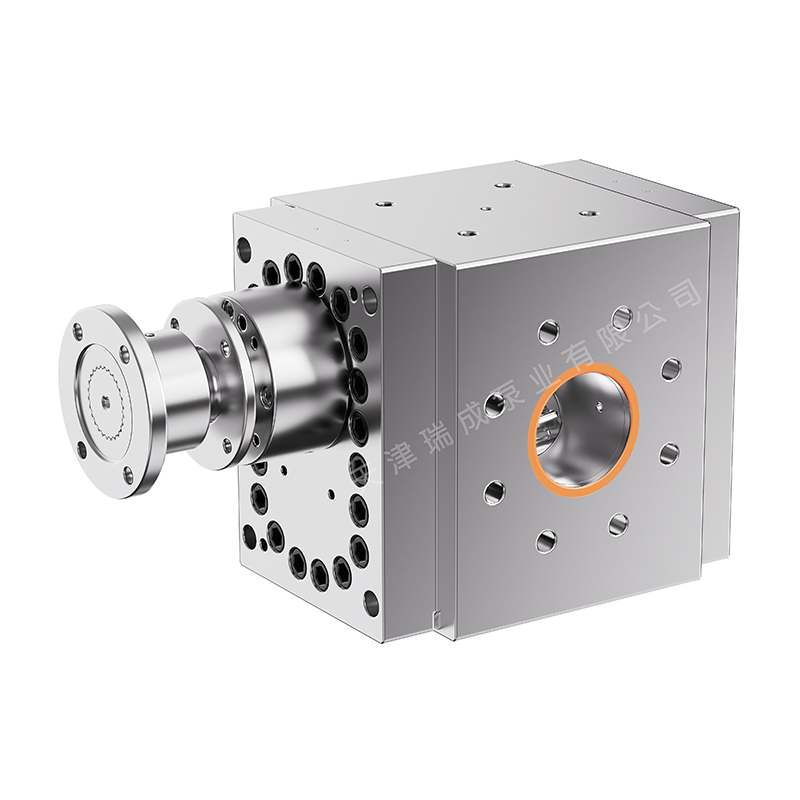
In plastic extrusion, rubber processing, hot-melt adhesive delivery, polymer production, and composite materials manufacturing, an increasing number of production processes involve the conveyance of high-viscosity melts. These materials remain fluid at high temperatures but, due to factors such as molecular structure, material formulation, and processing temperature, typically exhibit high flow resistance, sensitivity to pressure changes, and require high conveyance stability. Therefore, production lines not only require equipment with sufficient conveyance capacity but also need to maintain stable melt pressure and flow rate.
As a positive-displacement conveying device, the melt gear pump relies on gear meshing to create a continuously varying working volume, thereby achieving the suction, conveyance, and pressurization of the melt. In high-viscosity applications, melt gear pumps are widely used in plastic extrusion, rubber extrusion, hot-melt adhesive application, and polymer processing due to their stable output, pressure control, and strong adaptability.
I. Stable Conveyance and Reduced Pressure Fluctuations
High-viscosity melt is highly sensitive to pressure changes during processing. When an extruder alone handles both plasticization and conveyance, factors such as raw material fluctuations, screw condition, and changes in filtration resistance can cause variations in outlet pressure, thereby affecting the feed rate to the die.
Installed between the extruder and the die, the melt gear pump uses rotating gears to create stable volumetric delivery, continuously feeding the melt from the front end into downstream equipment. Since the output per gear rotation is relatively fixed, this reduces the impact of melt pressure fluctuations on the production process, providing the die with more stable feeding conditions.
Stable melt pressure helps improve product dimensional consistency and enhances the controllability of the production process.
II. Adaptability to High-Viscosity Material Conveyance Requirements
High-viscosity materials are prone to increased flow resistance and filling difficulties during conveyance, placing high demands on the internal structural design of the equipment.
Melt gear pumps utilize a precision gear mechanism; once the melt enters the gear working area, it is carried to the outlet as the gears rotate, enabling continuous conveyance. To accommodate different material properties, the equipment can be configured—including gear structure, pump body material, bearing type, and sealing method—based on process parameters such as viscosity, temperature, and pressure.
III. Reducing Flow Fluctuations and Improving Metering Stability
In certain precision manufacturing fields, variations in melt flow rate directly affect product quality. For example, during chemical fiber spinning, changes in melt pressure may affect fiber diameter; in cast film production, fluctuations in material supply may affect film thickness uniformity.
Melt gear pumps use a positive displacement conveying method. By controlling the motor speed to adjust the output volume, they can achieve relatively stable melt conveyance. At the same time, the equipment can provide a certain degree of pressure boosting during operation, resulting in smoother pressure control along the production line.
For production equipment requiring continuous operation, stable melt delivery capacity reduces the frequency of process adjustments and improves the efficiency of production process management.
IV. Meeting Requirements for Continuous High-Temperature Operation
High-viscosity materials typically need to remain in a fluid state at relatively high temperatures; therefore, conveying equipment must possess excellent heat resistance.
Melt gear pumps are typically equipped with heating systems to maintain the pump body and internal flow channels at an appropriate temperature, thereby reducing viscosity fluctuations caused by temperature changes. Additionally, key components such as the pump body, gears, and shaft sleeves can be made from materials selected based on the characteristics of the material being processed to meet requirements for wear resistance, corrosion resistance, and long-term operation.
V. Widely Used in Various High-Viscosity Production Fields
In the hot-melt adhesive industry, it can be used for metered delivery of adhesive compounds, as well as coating and lamination processes;
in the rubber industry, they are used for the conveyance of high-viscosity compounds and extrusion production;
in the plastics industry, they are used for the extrusion and modified pelletization of materials such as PP, PE, PET, ABS, and PA;
in the chemical fiber industry, they are used for stable material supply during the spinning process.
Equipment parameter requirements vary across different application areas, so selection must be based on a comprehensive evaluation of factors such as material viscosity, operating temperature, pressure range, and production capacity requirements.
VI. Selecting the Right Model to Ensure Optimal Equipment Performance
When selecting a melt gear pump for high-viscosity applications, several key factors must be considered:
First, determine the pump’s displacement and speed range based on the production line’s output. Second, select the appropriate pump housing design and materials based on the material’s temperature and pressure. Additionally, factors such as seal type, heating method, and installation interfaces must be taken into account.
Only when equipment parameters are matched to actual process conditions can melt gear pumps fully demonstrate their effectiveness in high-viscosity conveying.
High-viscosity melt conveying places higher demands on equipment stability and adaptability. Thanks to their positive displacement design, melt gear pumps offer excellent performance in terms of stable feed, pressure control, flow regulation, and high-temperature operation.
Tianjin Ruicheng Pump Industry continuously focuses on the needs of different materials and production processes. Through structural design optimization and adaptation to operating conditions, the company provides reliable melt conveying equipment for the plastic extrusion, rubber processing, hot melt adhesive, chemical fiber, and polymer industries, helping customers improve the stability of their production processes and optimize equipment compatibility.